First off, a quick update: I’ll be attending both TIFF and San Sebastián back to back in September. While I have paid work for both (very open to more!), I will do my very best to write up everything I see that I’m not being paid to cover over here. So, there should be substantial cinematic content to come that isn’t just me self-promoting or food (though I do expect to be dashing off more food posts as part of The Travel Experience). But for now…I’m self-promoting. Fortunately for me, everything in this round-up is related to legacy, thereby making it seem like I planned all this.
First up: David Ehrlich asked me if I had anything to contribute to Indiewire’s “Sequels Week” and generously gave me the unsupervised scope to just go and do some granular interviews with craftspeople as is my wont. In this case, I talked to actor Alex Winter, costume designers Alex Kavanagh and Luis Sequira and graphic designer Teddy Blanks. Here’s one of my favorite bits, Kavanagh explaining the complicated afterlife of one of her wardrobe sets:
After “Land,” Kavanagh returned for the lower-budgeted final installments, “Diary of the Dead” and “Survival of the Dead.” “On ‘Land,’ we had zombified a huge stock of clothing for all the background and stunts,” she noted. “At the end we sold it to a local company that was starting a costume rental house. When we went to do ‘Diary,’ there was such a tiny budget I didn’t know how we were going to do the bigger scenes, but I was able to get back the whole stock from ‘Land’ (it had been in storage and never used), which I sent back at the end of filming—and was able to get again for ‘Survival.’ So, if anyone looked closely, there are some of the same clothes on the zombies in all three films. That stock then went to ‘Resident Evil 5.’”
That whole piece is here.
Next up, an interview with Isabelle Huppert, who objectively has to be one of the most famous people I’ve interviewed, as celebrities are generally not in my wheelhouse. The prompt was the recently-completed retrospective at L’Alliance New York of six of her seven features with Claude Chabrol. This also gave me an excuse to watch or rewatch six of them myself, which was hugely gratifying. (A big big thanks to Jake Perlin, L’Alliance’s programmer, for making this all happen.) Here’s some of that:
When we shot Violette, we didn’t shoot in the studio; we shot in a very small apartment in the 15th arrondissement in an old building. He would always say something funny: “It’s not so difficult to find where to put the camera, because there is only one possible place,” meaning that the space was so narrow. That’s how he would define his choices, in terms of where to put the camera: There is only one possible place. The angle was obvious because there was no choice to make between two angles.
He wrote a book called No Matter What, I Shoot. [The 1976 book’s title is et pourtant je tourne…, which translates as And Yet I Keep Turning—a translated pun on Galileo’s Italian statement “E pur si muove” about the earth: “And yet it moves!”] That was a good summary of Chabrol’s attitude regarding moviemaking. He had to shoot, to work, to make movies. He was perfectly aware that certain ones were better than others, and he didn’t have this pretension of being a genius each time. But he had to shoot and make movies no matter what. I would have made more films with him if he had not left us so quickly.
That whole piece is here.
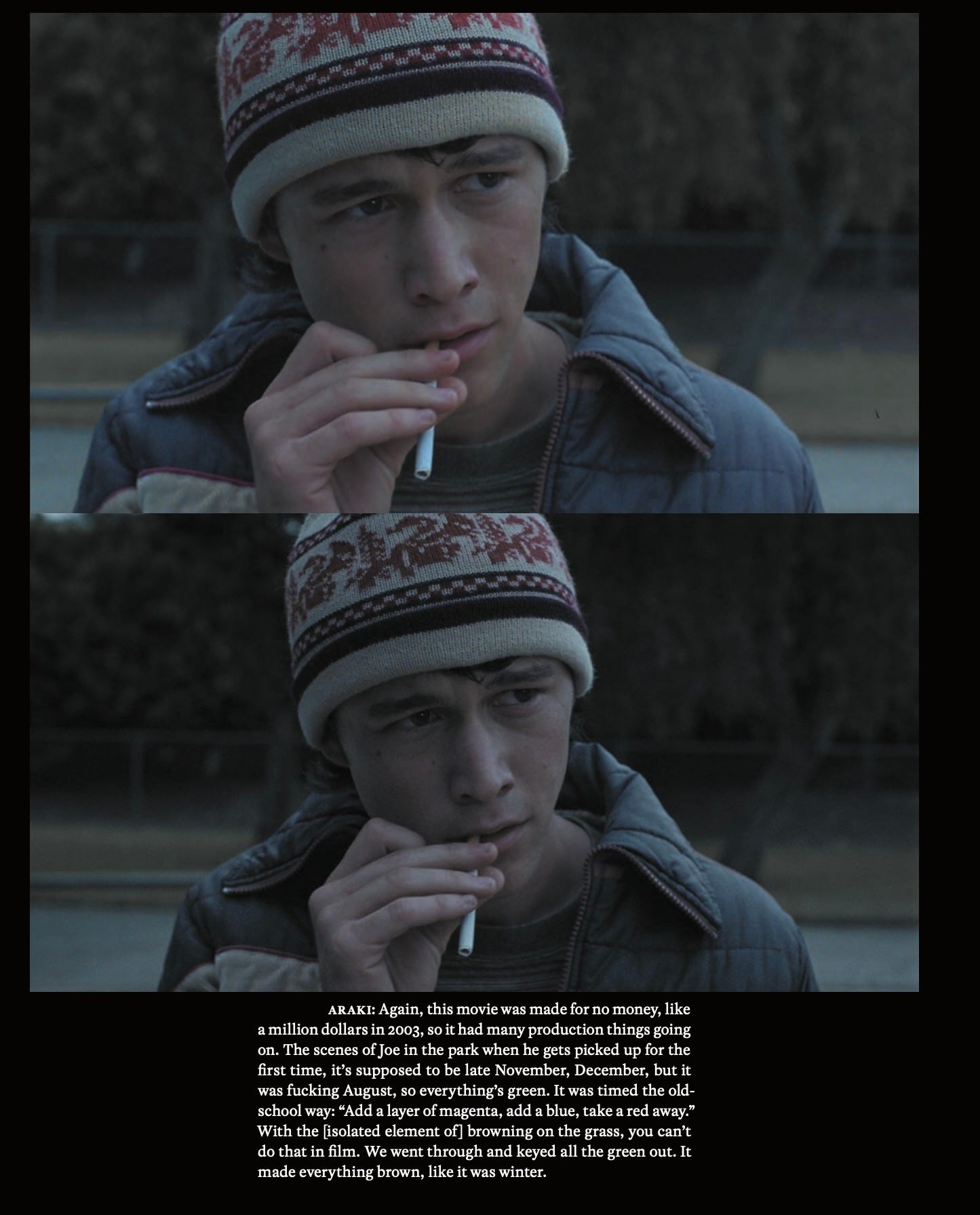
Lastly: not a new piece, but one whose time has come back around. For my last print issue of Filmmaker, I interviewed Gregg Araki and the team behind the new 4K restoration of Mysterious Skin, which is beginning its theatrical run today. It was a lot of fun to get into those particular weeds, as this is definitely not a purist restoration. The beginning of that:
Toward the end of my interview with Gregg Araki, I remind him of his scene from Michael Almereyda and Amy Hobby’s 1995 documentary At Sundance. Sitting on a couch next to Todd Haynes, Araki is at that year’s festival with The Doom Generation. “The first draft of Doom was done when The Living End premiered at Sundance in 1992” he says. “The hard part is always the money and the financing, and it gets worse, and worse and worse [….] I hate the fact that you write, you make a movie, it’s fresh and what you want to say and urgent. It’s your thing. And then, three-and-a-half years later, you’re talking about it in interviews like this.” Araki laughs when I ask whether anything has changed in terms of production time and difficulty level: “My new movie is fucking never-ending. All movies are like that. Look at Mysterious Skin: that movie was [more than] 20 years ago, and I’m still working on it.”
And the whole piece here.
One more thing on the latter: when converting the article for online, I chose to not also include the last three pages of the issue, which are compare/contrast examples of Skin before and after the restoration, in part because I understood the kind of message board chaos that would ensue when nerds see these types image and take to the internet and didn’t want to inflict that on any of the team. But it seems safe to sneak one image in here now that the film is meaningfully back out in the world, so here’s the last page of my final issue: