On "The Christophers"
Fake can be just as good as real (?)

I care about Steven Soderbergh enough to watch everything he’s done this century minus the second season of The Knick (the script defeated me). His copious work has come out through a variety of underpromoted channels; for example, many seem unaware of the last thing he did I found fully satisfying, the 2023 HBO Max five-episode series Full Circle (among other things, an excellent portrait of the kind of rich people who live near NYU). And it certainly seems like even fewer people heard of Command Z, a Kurt Anderson-scripted web series with unabashed didactic intent; I sat right up when one episode proposed that Democrats need to embrace nuclear power to win back the working classes, which is definitely a thesis. (Kamala Harris advisors, please don’t read this.)
It’s clear Soderbergh has no problem being very direct when it suits him, so what’s going on with The Christophers? Two main dialectics underpin the relationship between elderly painter Julian Sklar (Ian McKellen) and his brand-new assistant Lori Butler (Michaela Coel). The more obvious one is the ontologically vexing, irresolvable question of What Makes Art Art. Lori has been hired by Julian’s children to forge completed versions of his titular unfinished series of paintings. A Blonde Redhead album proposed that Fake Can Be Just as Good as Real; the movie wonders if that is true. Obviously, this has implications for filmmaking—traditionally the product of multiple voices, of which Soderbergh has tried to eliminate as many as technically and fiscally possible by being his own DP, editor and returning to working within his own production apparatus after doing studio and streamer time. When does collaboration yield rich synthesis and when does it just cross over into dilution?
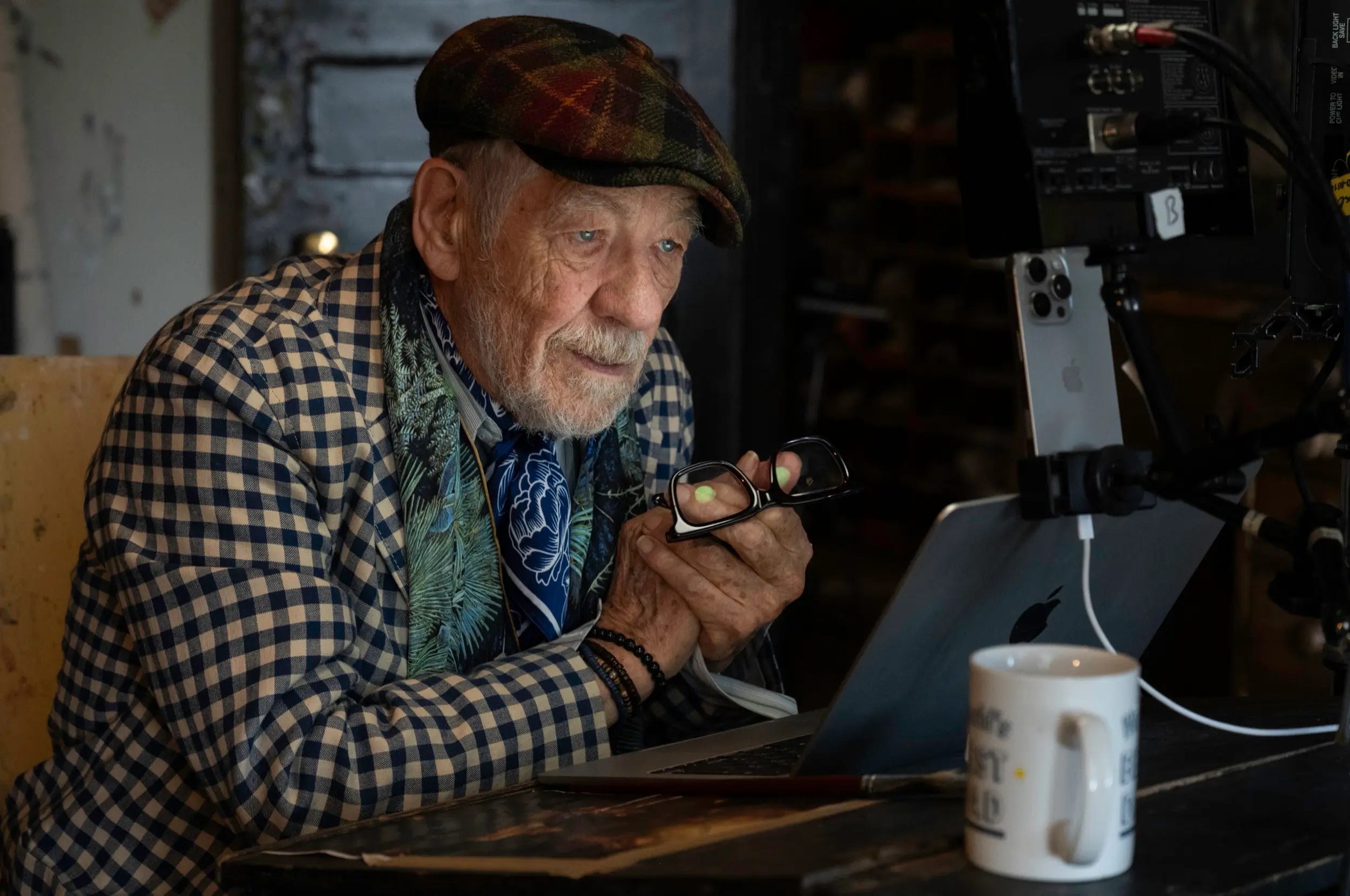
I don’t know that the film really does anything with this question other than gesturing vaguely in various familiar directions, though it’s an enticing proposition probably because it can never be resolved—art is mysterious! I’m more frustrated by The Christophers’ other evasions. The main attraction is the odd couple duo of Julian and Lori—old vs. young, white vs. black, posh establishment vs. scrappy up-and-comer, politically regressive vs. progressive—but nothing really comes of these frictions. It’s implied that Julian was canceled for saying various objectionable things, although we never really learn what those are, save that he was on a reality TV show where he was the Simon Cowell member of the panel. Doling out rude, ostensibly witty insults to young artists isn’t really getting MeToo’d, or even the equivalent of Hito Steyerl’s pro-Zionist sentiments, which should surely also scan as a red flag to Lori.
Lori once admired Julian’s work but has since come to cancel him from her own aesthetic canon, and—towards the very end—we learn why that really happened: a piece of backstory gives them a connection that began earlier than Julian realized. I find this exasperating, as it turns out Lori can’t have just an intellectual and aesthetic aversion to Julian—sure, the political is personal, but this almost implies that the political could only be personal. I need a zoomer-vs.-boomer ideological throwdown like I need a third Trump administration—but OK, if we’re going to do this, shouldn’t we try to flesh out what that might actually mean, what the stakes are and how they could be higher than personal beef? Come back TÁR, all is forgiven.
An obligatory note here that both leads are tremendous and worth the price of admission; McKellan hasn’t looked this dialed-in in years, while Coel is a personal favorite from one of my rare forays into recent TV, I May Destroy You (one of my favorite title uses of the conditional tense). While Soderbergh is 100% a more competent DP than similar apparatus-eliminator Hong Sang-soo, his current lens kit is driving me off the wall, super-blurry around the edges and kind of bizarrely ugly for no particular reason. Finally, a spoiler: as I understand it, for some time now Soderbergh has been coming up with ideas or situations, then giving him to a small stable of screenwriters to flesh out. I can’t help but note that this is the second film he’s made under that model, after 2020’s (delightful) Let Them All Talk, where an older artist who’s quarreled with previously close friends befriends a young admirer, then dies. This is either a symbolic baton-passing or something a little more maudlin; I’m not sure which.